This page is dedicated to the ocean and marine animals, join me as I dive the depths to discover the secrets of the fascinating marine animals.Love the ocean.Protect the ocean.
Hi everyone...Hope ya'll are doing well. It has been such a long time since i updated my blog. Truly has been busy years... starting to work and being committed to it. But here i am, back to blogging! I shall start up with describing my recent trip to the ocean. I went to Perhentian Island in this September, it is a truly magical island. I have been to Redang Island, Tioman Island,Penang Island, Langkawi Island, all of these islands have some special features about them and all are unforgettable.
However my trip to Perhentian Island has once again quenched my thirst for the marine animals and being close to the them and see many species i have not met underwater. In this trip too, I took up three PADI specialties and I am now a certified PADI Adventure Diver! The specialties i took are Peak performance Buoyancy, Underwater Navigator and AWARE fish identification. Although being a relatively new and young diver, my instructors are very happy and impressed with my ability underwater. Especially Fish ID specialty, where I was able to identify many species of fish.I am truly blessed to have chosen Perhentian Island for my Adventure diver course.
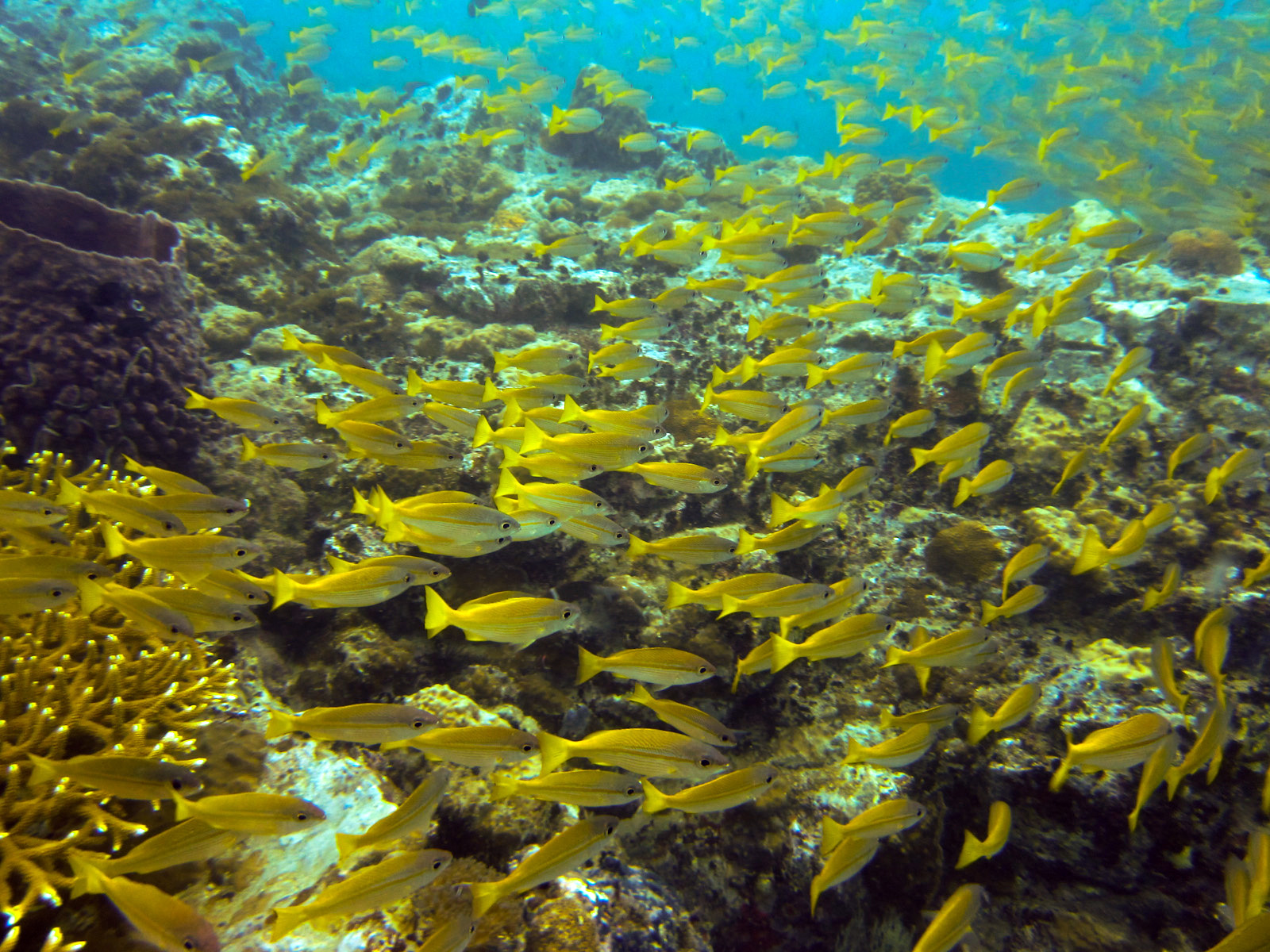
The dive sites i have been to are Batu Nisan, Batu Layar, The Lagoon and Temple of the sea. The two most unforgettable dive sites are Temple of the sea and The Lagoon. Temple of the sea gets its name by its shape. It has a small pinnacle about half a meter above the ocean, but when you plunge into the water, it is actually build up of a mountain of corals in the shape of a temple! I dived into the bottom of the temple of the sea - it was 27m in depth! In this depth, the thermocline was 4 degrees, and it was an abrupt change in temperature,in the cold and mist of mere visibility of 5m, me and my instructor knelt on the ocean bed and there is a bamboo shark that came swimming in between us, which is a really rare scene, cause they are nocturnal and shy animals, likes to hide beneath the rocks! Swimming around the mountains of corals is a truly magical experience, i was surrounded by a big school of yellowtail snappers, literally surrounded....
The corals shine in its healthiest condition and its bright colours prevails.
Diving in The Lagoon is a really exciting experience, many times i would say to myself, oh my god, am i dreaming... the beauty of the corals and the abundance of marine lives are thrilling! I saw a black spotted pufferfish in its full size, a huge brown marbled grouper, blue spotted fantail rays, freckled goatfish and a cleaner shrimp !! A truly hearthrobbing experience.
Cruising in the ocean brings me calmness and serenity, i wish i can dive everyday...
If you love the ocean and marine animals and you are not a certified diver yet, what are you waiting for?
I promise you will only gain as a diver and discovers depths about the ocean, and, about yourself too.
Love the ocean.Protect the ocean.
Lastly, i would like to encourage people who are in difficult times in their lives,
hold to the truth in your heart and believe in yourself, You've come so close, don't throw it away.
Hold on together and beautiful days will come.
***pictures abstracted from the internet, sorry not a underwater photographer yet...the day shall come.=)
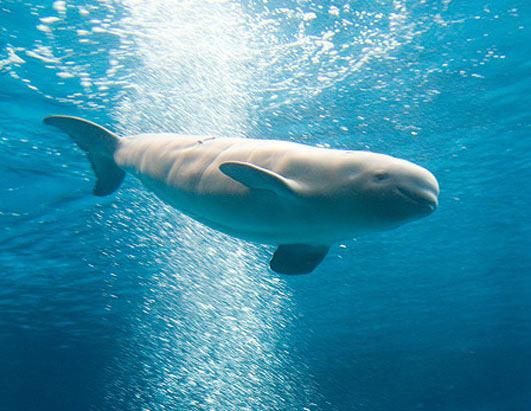
HI everyone! It has been a long time since I posted the last blog, it is great to be back to this underwater world. I have the privilege of going to Harbin, China on February and I met two gorgeous Beluga whales in Harbin aquarium. They were brought in from North pole, where their natural habitat is and they were trained to do shows for us in order for us to understand more about ther species in effort to protect them.
Belugas at Harbin Aquarium
I have never thought I would be able to see Beluga so close up, literally inches away in the aquarium swimming freely and having lovely smiles on their faces. Although the water space they were put in is very small compared to the big ocean that they used to live in, hopefully they will be able to understand the purpose of them being kept there and be able to thrive in the aquarium.
The word beluga comes from the Russian word "bielo" meaning white.
Baby Belugas are born gray to enable them to hide in their mother's shadow and gradually turn snow white to blend with the ice and snow. (PIC) Their bulbous forehead, called a "melon", is also flexible and capable of changing shape by blowing air around its sinuses. This allows them to make different facial expressions and produce a series of chirps, clicks, whistles and squeals, which give the beluga its other name, "the canary of the sea.
Belugas, like other arctic whales, do not have dorsal fins (a dorsal fin causes extra heat loss and would be a major hindrance in the arctic ice), but they do have a tough dorsal ridge. They also have a thick layer of blubber that insulates them from the icy arctic waters. They travel in a group of 5-20 animals, but sometimes more than one thousand are spotted together. They consume various fish species, squid, and krill. It most probably does not dive any deeper than 300 m.
The females reach puberty at the age of five and the males at eight. Mating takes place when the ice melts, the gestation period is about 14 months and the calf is 1½ m long and weighs 80 kg at birth. They start turning white 5-12 years of age. No other whale species produces such a variety of high frequency sounds and only two other species can move their heads as freely as the beluga whale.
This is a video of Beluga performance that is found in Youtube, not the same as the one I watched at Harbin, but this showcase how intelligent they are. Enjoy!
This video shows a birth of a baby beluga whale at Shedd aquarium Chicago. Puiji is the mother and the calf is Ninavik. =)
Thank you and i shall see you soon! have a nice day.
I hereby pray that all the people that have died from the earthquake and tsunami in Japan to rest in peace and their family to be blessed with safety and happiness. May God and the ocean be with you.
Puffer Fish are probably one of the fish in the sea that shows its emotions through body language. When relaxed and calm, puffer fish has this little mouth that its shape almost suggest that it is smiling welcomingly.
But when it is provoked, it definitely will let you know that it is pissed!
I sure do envy puffer fish, if only I can puff up like a ball with poisonous spines when there is danger. Then I can get rid of my stupid protective alarm that goes off all of sudden in class, and I can throw away my pepper spray that is difficult to use in emergencies. But what if I can’t deflate myself afterwards,…hmm…anyway, the point is, the puffer fish, being small relatively, has got nature’s gift to ultimately protect itself from predators.
The puffer fish can puff up to 2-3 times its usual size! It only does that when it is put into tremendous stressful condition. Aquarium keepers are advised not to transfer a puffer fish out of water, because puffing air is much more dangerous for the fish than puffing water.
The ability to puff is very important for puffer fish because they move slowly and clumsily in the water, will not have enough time to escape from predators if they are under attack. They use their highly elastic stomachs and the ability to quickly ingest huge amount of water to turn themselves into a virtually inedible ball several times larger than their normal size. Some species have spines on their skin to make them even less palatable.
Predators that manage to snag a puffer fish before it inflates might laugh away feeling lucky, but it will not feel lucky anymore to know that almost all puffer fish contain tetrodotoxin. This substance makes them foul tasting and lethal to fish. Tetrodotoxin is deadly to human, it is up to 1,200 times more poisonous than cyanide. One puffer fish has toxin enough to kill 30 adult humans, and there is no known antidote! Don’t mess with a puffer fish.
Okay, maybe only if you are a professional.
Puffy Puffer Fish Puffs! :p
I hope all of you will get puffed up with joy and warmth in your heart and say no no to ego. This is my 10th post since November 2009 and I am absolutely thankful and happy for those who visits this page on a regular basis. With God’s grace I shall continue my little contribution to the ocean, marine animals and the nature and continue this cause for the rest of my life. May you join me as well and together we can make a difference.
p/s: I recently found out that Ellen Degeneres is actually the voice of Dory in Finding Nemo!! Silly me, took me so long to realize, but i just feel it is absolutely amazing that one of my favourite hosts is my favourite fish in cartoon!! okay, it doesn't sound right but who cares! wohoo... hehehe..... bye guys!
Hello peeps!! Hope you are out enjoying the sun! Growing up watching Disney’s cartoons, I love almost all Disney cartoons and can memorize most of them even their songs! Many of the ideas that Disney cartoon came from the nature and animals. How many kids got named after Disney characters, because their parents want them to grow up as adorable as their favourite characters. The only marine animal in the ocean that is named after a Disney character actually has the feature of the Disney character, Dumbo, which is why it is given the name Dumbo Octopus. This is how it looks like...
Dumbo Octopus
Perhaps this video can bring back sweet memories of sitting in front of TV with siblings and crying over touching story of Dumbo… =)
Unlike other species of octopus, Dumbo octopus has ear like fins which helps it moves gracefully in the deep sea, around 300-400 meters below surface. It has soft body(semi-gelatinous), which allows it to live in great depths. It swims by flapping its fins, expanding and contracting its webbed arms, or by shooting water through its funnel. All of these techniques can be used separately or simultaneously. This make them really good swimmers and escapers when under attack.
It is an octopod, which means it has 8 arms. The arms are connected to each other, close to the tip, which is called webbing. It can grow up to 8 inches. The size and the pattern of suction pads vary between the male and female Dumbo Octopus. It feeds on shrimps, small fish and worms. Dumbo octopus differs from other species by swallowing its prey as a whole.
There are 14 known species of Dumbo Octopus. They appear to live near the seabed, just above it. They can live up to 7,000 meters of depth, which is the deepest depth of any octopus.
Having found multiple eggs at various developmental stages in dissected females, they presumably lay eggs all year long instead of having a breeding season. The male Dumbo octopus has an enlarged segment on one of his arms which is used to transfer spermatophores (packets of sperm) into the female's mantle cavity. Once transferred, the packets will rupture so the sperm can fertilize the eggs. The female will then lay the eggs underneath rocks and shells and leave them to fend for themselves.
The eggs are usually quite large in size and when hatched, the young are believed to be quite advanced in terms of development.
Here is videos of Dumbo octopus,
Maybe because of its name, I feel very familiar with Dumbo Octopus and think its very adorable as well.
Like Disney cartoons, we should always believe in ourselves, come what may, should never give up and keep trying, and with God’s permission, success will be rewarded. Hope everything goes well for all of you and keep believing and have faith, and most importantly, be happy… cause life is too short to ponder over things, cause the past is a history, the future is a mystery and to have you reading my post right now, is a present.
God bless all of you. Please be safe and sound. See you soon. =)
Warm greeting to everyone! The sun is shining more often here as I bring ya all for another great adventure in the sea!
As some of you enjoy water activities, when you look down to the seabed, it often seems to be uniform with stones and corals, but were there truly only corals and fish? What may be happening down there at the seabed, is far more interesting than what we can see!
The ocean is full of masters of camouflage and meet the master of camouflage of all fish, the stonefish. Stonefish is the deadliest fish in the ocean. This is the reason why you should always wear protective shoes/fins and do not touch anything with bare hands in the water. Stonefish, as its name suggest looks just like a stone, even if it is right in front of your eyes, you may find it hard to spot. It has thirteen sharp dorsal spines on its back, which each have extremely toxic venom. The venom of a stonefish can kill a human in two hours.
Stonefish commonly dwells in shallow water (about 3meters depth) although it can be found in much greater depths. They often cling to algae covered rocks where it anchors itself effectively to the seabed, merging perfectly with the background. It uses suction power to feed on fish and shrimps that passes by.
The greatest danger of being stung is when wading through the shallows, across the reef-top, and especially near the reef-edge. When walking it is a good idea to shuffle one foot in front of the other rather than to take big strides in which each foot is raised up and then placed down onto the seabed with the risk of landing on a stonefish. The shuffle motion will increase the likelihood that you scare a stonefish away from your tracks rather than precipitate its ire by descending from on high onto its potentially lethal spines.
13 spines on the back of a stonefish.
In the event that you are stung by a stonefish do not panic. Although the pain will be excruciating stonefish stings are generally not fatal. When the stonefish is trodden on, or otherwise angered, the spines lock into an erect position and poison is injected into the foot or other offending body-part. The poison itself is an unstable, high molecular weight, protein that has an effect upon muscles including respiratory and heart muscle. Early symptoms after a poisoning include :
Airways and lungs o Difficulty breathing Heart and blood o Collapse Skin o Bleeding o Severe pain at the site of the sting o Whitened colour of the area around the site of the sting o Colour of the area changes as the amount of oxygen supplying the area decreases. Stomach and intestines o Abdominal pain o Diarrhoea o Nausea o Vomiting Nervous system o Delirium o Fainting o Fever (from infection) o Headache o Muscle twitching o Seizures o Paralysis
What To Do when someone get stung by stonefish?
1. Find a source of HOT water. (NOT boiling but as hot as patient can stand without physically scalded). 2. Clean the wound, remove any debris, place the site of wound into hot water for at least an hour. (Poison denatures at temp of 50 degrees celcius in laboratory) 3. The patient should be made to lie down and the injured foot (or other body-part) should be elevated above the rest of the body 4. If potassium permanganate is available, a weak 5% solution of this can be used to wash out the wound.
Here is a video of stonefish. Enjoy!
Recently have to say goodbye to a group of friends who I get to know very well after 5 weeks of rotation. Some people you only see once in life, and wonder when you going to meet them again. It is the beauty of life to get to meet different people everyday, though its always difficult to say goodbye. I hope them well and will always keep them in my prayers. Please be safe till we meet again.
To begin my post, I would like to pay respect to Dawn Brancheau, a 40-year-old trainer in Sea World, Orlando who is the victim of the killer whale attack that happened on 24/2/10 and may you rest in peace.
Dawn Brancheau, was rubbing Tilikum from a poolside platform when the 22-foot creature grabbed her ponytail in its jaws and pulled her in. Witnesses said the whale played with Brancheau like a toy.
"He kept pushing her and poking her with his nose," said Paula Gillespie of Delaware, who saw the attack from an underwater observation point. "It looked like she was just totally caught off guard and looked like she was struggling."
Tilikum, 12,000 pound male orca in Sea World has killed 2 persons in the past and this is the third kill where the victim is her trainer who has 16 years of experience in training orcas and has dreamed of becoming a trainer since young. I suppose there are many questions going, why is Tilikum still be used in shows while she had been involved in so many deaths? Should orcas be continued to be seen in shows with people or trainers with them in the waters or should the killer whales shows be banned and released to the wild? What is Tilikum’s fate from now on? What is the public’s view on killer whales after the attack? If Tilikum is to be released into the wild, will she be alright? If the trainer is able to speak for herself, what will she want to be done to Tilikum and will she regret for being a trainer.
To find an answer and justice to all these questions, there are few things that we need to look into.
Firstly, the motive of bringing in killer whales in shows.
Killer whales are well known as malicious killers and good hunters in the sea and it take years and very risky to get a killer whale trained and to be able to perform with trainers/ audience in a live show. So why do we still do it then? Simply to plant the seed of love to the ocean and marine animals and to let people see the lovely side of the killer whales. It is very educational in help of preventing extinction and conserving the species.
Secondly, the natural interaction of orcas. The animals establish dominance and communicate their social order by slapping their tails against the water, head-butting, jaw-snapping, biting, raking (tooth-scratching), and other vigorous postures and gestures. Numerous tooth-scratch marks can be seen on this killer whale. Sometimes tooth scratches can leave a killer whale with scars, but generally these scratches are superficial and heal quickly. So, was Tilikum trying to interact/play with trainer?
Thirdly, trainers teach Tilikum how to do skills and perform in front of audiences, but did anyone teach Tilikum that killing someone is wrong? Was it properly punished and told that it was wrong and that it will result in death from the last two times it was involved in killing? Is it possible to find a way to tell her that that behaviour was wrong?
If Tilikum is to be released into the ocean, her natural habitat after many years of being in a small pool, will she ba able to cope in the ocean?
Chuck Tompkins, chief of animal training at SeaWorld parks, said that Tilikum would not survive in the wild because it has been captive for so long, and that destroying the animal is not an option either, because it is an important part of the breeding program at SeaWorld and a companion to the seven other whales there.
Brancheau's older sister, Diane Gross, said the trainer would not have wanted anything done to the whale. "She loved the whales like her children. She loved all of them," said Gross, of Schererville, Ind. "They all had personalities, good days and bad days."
In a profile in the Orlando Sentinel in 2006, Brancheau acknowledged the dangers, saying: "You can't put yourself in the water unless you trust them and they trust you."
A trip to SeaWorld at age 9 instilled a desire in her to work with marine animals. She attended the University of South Carolina and majored in psychology, but got a job at a New Jersey park after graduation, working with dolphins and sea lions. She was hired at SeaWorld in Orlando in 1994.
This is a video i found on youtube, In Memory of Dawn Brancheau.
My personal view on this is, Tilikum has spent most of his life in the pool. We do not know what does Tilikum want for himself. Although we think that Tilikum might not survive if it is let free to the ocean, we shall give it a try. Orcas are meant to be in the big oceans with clans of same species and migratory animals, years of being in a small pool has taken away his freedom and his ability as an orca. Although it might require lots of human resource and money to bring him back to the ocean and monitor his progress and adaptation in the ocean, nevertheless, we must remember years of service he gave to Seaworld and countless entertainment and educational purpose he served us.
As for the killings he had committed, I think it should be treated as an accident and more improvement in terms of safety should be done. Such as special designed diving suits with emergency oxygen supply or a hit button that can fill the diving suit with air and makes it float. Build a railing on the shallow deck while dealing with orcas.
The ocean and marine animals are unpredictable in nature. I believe all marine lovers realize that. From the day I become a scuba diver, I know the risks it involve and know that some dismays are inevitable. But for the love for the ocean and marine animals, I take the risk and will not blame anyone or anything if any accidents or dismay happen to me while I am diving. I believe that Dawn feels the same as well and will not blame
Tilikum or Seaworld for this accident to happen. May the fate of Tilikum be as Dawn’s wish. May her spirit lives on and be happy surrounded by angels and God.
I hereby send my condolences to the family members of victims of tsunami and earthquake in Chile and other places involved. May God shine the light of hope to you.
Please leave comments and thoughts in chatbox at bottom of page. Thank you.
The Irukandji Jellyfish (Carukia barnesi) inhabits waters of Australia. This is a deadly jellyfish, which is only 2.5 centimeters (with bell and tentacles) in diameter, which makes it difficult to spot.
The term Irukandji refers to an Australian Aboriginal tribe that inhabited the Palm Cove region of northern Queensland where the Irukandji syndrome, produced by the irukandji stings poison, occurs most often.This is a species of jellyfish that has been known about in recent years, due to deaths of swimmers in Australia.
The jellyfish itself was identified in 1964 by Dr. Jack Barnes.
Irukandji has stingers not only on its tentacles but also on its bell.
Irukandji is very small and fragile, it cannot be kept in a normal aquarium because if they hit the side the impact will kill it. It is very fragile yet very deadly!
Irukandji syndrome symptoms:
The initial sting is typically mild and is followed, minutes to hours later, by vomiting, profuse sweating, headache, agitation, rapid heart rate and very high blood pressure and the worst pain throughout the body. The increase in blood pressure may be life-threatening and can be associated with abnormal heart beat and heart failure. The symptoms may last from hours to several days, and victims usually require hospitalisation. The survival depends on whether the body can withhold the shooting high blood pressure. There is no antidote for the venom of irukandji, the treatment is symptomatic. This includes giving IV morphine(still cant relief the pain some victims ecperience), alpha-blockers, fluids.
Irukandji attack prevention
Lycra stinger suits.
Some beaches erect enclosures ,stinger nets, but Irukandji can still filter through the net. Take the right precautions, you can take steps to minimize the exposure and still enjoy all the wonderful beauty of the reef. Talk to specialised dive operators for further advice. Please remember to get out of the waters if you feel tiny bits of sting and see nothing.
Here is another video of Irukandji attack. Enjoy.
Lastly, I would love to wish all divers and snorkelers around the world to be in the waters safely and have wonderful experience in the sea.
Thank you.
Please leave comments and thoughts in the chatbox at the bottom of page.
Merry Christmas everyone... On this festive day, I am bringing you to somewhere special. So hop in the boat and we are heading to Christmas Island!
Christmas Island is an Australian Non-self Governing External Territory, located in the Indian Ocean on the rim of South East Asia, 360km south of Java and 2600 km North West of Perth.
The Christmas Island red crab is by far the most obvious of the 14 species of land crabs found on Christmas Island. It is estimated that 120 million of these bright red land crabs live in their preferred shady sites all over the island.
What is so special about this red crabs?
It is The Annual Migration To The Ocean
At the beginning of the wet season (usually October / November), most adult Red Crabs suddenly begin a spectacular migration from the forest to the coast, to breed and release eggs into the sea.
Below is the video to show its impressive swamp of red invading the town. Basicly everywhere in the island.
I find the rule in golf impressive! Perhaps that is the only place in the world where crabs can help you score in golf game. They are helpful in some ways. =)
Bright red is the common colour but there are the occasional orange specimens and more rarely some purple animals. They are a big crab. An adult body shell (or carapace) may measure up to 116mm across. The Christmas Island red crabs' carapace is round shouldered and encloses their lungs and gills.
Their claws are usually of equal size unless one is a regrowing claw. Males grow larger overall than females, while females have a much broader abdomen and usually have smaller claws than males.
Christmas Island red crabs grow slowly, reaching about 40mm in carapace width after 4-5 years. They are sexually mature at this age and begin to participate in the breeding migrations.
The Christmas Island red crabs moult their shells regularly during their early growth phases to match their increasing body size. Moulting usually takes place in the protected moist environment of their burrows. Mature Christmas Island red crabs probably moult only once a year, as their growth rate slows.
Red Crab Diet
Red Crabs diet consists mainly of fallen leaves, fruits, flowers and seedlings. They prefer fresh green leaves but will eat any fallen leaves. They are not solely vegetarian however. They will eat other dead crabs and birds, the introduced Giant African snail and palatable human rubbish if the opportunity presents itself.
Red Crab Habitat
Red Crabs are diurnal (active during the day) and almost inactive at night despite lower temperatures and higher humidity.
Crabs retreat into the humid interior of their burrows during the dry season. They plug the burrow entrance with a loose wad of leaves to maintain a high humidity level, and effectively disappear from view for up to two to three months of the year.
The Breeding Calendar
Males lead the first wave of the downward migration and are joined by females as they progress. Larger males arrive at the sea first (after about 5-7 days) but are soon outnumbered by females.
The crabs replenish moisture by dipping in the sea, then the males retreat to the lower terraces to dig burrows. The density of burrows is high (1-2 per square metre and fighting occurs between males for burrow possession. The females move to the terraces and mating occurs, usually in the privacy of the burrows that males have dug and fought for.
The females produce eggs within 3 days of mating and remain in the moist burrows on the terraces for 12-13 days while they develop. The eggs are held in a brood pouch between their extended abdomen and thorax. A single female can brood up to 100,000 eggs.
In the morning and late afternoon around the last quarter of the moon, the egg-laden females descend from the terraces to the shoreline. They pack into shaded areas above the waterline at densities of up to 100 per square metre in places. The females usually release their eggs into the sea toward dawn, around the turn of the high tide. Release of eggs may occur on 5-6 consecutive nights during the main breeding migration. After the first two days, eggless females may be seen crossing plateau roads, kilometres from the shore.
If the spawning migration is delayed or disrupted, usually because of unfavorable weather conditions, both male and female crabs will remain on the terraces for the next month and complete the spawning one lunar month later.
Larvae Grow To Baby Crabs In The Sea
The eggs released by the females hatch immediately on contact with the sea water and clouds of young larvae swirl near the shore before being washed out to sea by waves and tides. Millions of the larvae are eaten by fish and plankton feeders such as Manta Rays and the enormous Whale Sharks which visit Christmas Island waters during the crab spawning season.
After about a month in the ocean, and after growing through several larval stages, the surviving larvae have developed into prawn-like animals called megalopae. The megalopae gather in pools close to the shore for 1-2 days before changing into young crabs and leaving the water.
Impact Of Humans Certain human activities have led to increased numbers of Red Crabs dying during their annual migration to the sea.
To reduce the number of crabs killed by vehicles during the migration, 'crab crossings' are being constructed in roads which cross main crab migration paths. Points where high numbers of Red Crabs cross roads have been identified, and tunnels are built under the road for crabs to pass through. Walls that the crabs can not climb over are built alongside the road to 'funnel' the migrating crabs through the tunnels. These crab crossings may be seen on the Lily Beach road. Other conservation measures used by the community are road closures and traffic detours around the major migration paths during peak periods of the migration.
The Annual Migration To The Ocean
At the beginning of the wet season (usually October / November),
most adult Red Crabs suddenly begin a spectacular migration from
the forest to the coast, to breed and release eggs into the sea.
The timing of the migration breeding sequence is also linked to the phases of the moon, so that eggs may be released by the female Red Crabs into the sea precisely at the turn of the high tide during the last quarter of the moon. It is thought that this occurs at this time because there is the least difference between high and low tides.
Movement peaks in the early morning and late afternoons when it is cooler and there is more shade. If caught in open areas, in unshaded heat, the crabs soon lose body water and die.
Have a Merry Christmas and Happy New Year 2010! ! 2009 has been a remarkable year for me, some of the unhappiest thing and happiest things happen to in 2009. Certainly a year to remember in my diary. Be safe and take care.
Love the Ocean. Protect the Ocean.
Please leave your comments in the chatbox at the bottom of page. Thank you.
The most fascinating and colourful creature on earth has to be the nudibranchs or sea slugs. Always fascinated by the array of colour combination they demonstrate and the ability to camouflage. Almost a new species is found everyday. Up till now there are more than 3000 species known to human. Sorry for those who misread the title of this post, but this is a perfectly healthy page dedicated to the marine animals. Come on…
Nudibranchs or sea slugs represent fascinating and colourful life form. Their name is pronounced nudi - brank and it means "naked gill". As the name suggests the vast majority have gills outside their body and they have evolved without the protection of a shell. In all nudibranchs the shell is only present in the larval stage. As adults, the mantle replaces the shell.
They can be found throughout the world's oceans at all depths. The only place you will not find them are high energy areas, such as heavy surf close inshore where their soft body could be damaged.
Anatomy of Nudibranch
The mantle.
The surface of the mantle may bear tubercles which vary in size, shape and number and are often a character used to identify nudibranchs. Acid glands and/or spicules are incorporated in the mantle tissue and it is thought that these are mainly defensive in function.
Processes found in some species have coloured tips and contain defensive glands and have been shown to produce chemicals distateful to fish.
Cerata
The cerata contain branches of digestive gland.
The rhinophores.
The head region of nudibranchs bears a pair of sensory tentacles called rhinophores. These structures are primarily chemosensory (smell, taste) in function. In many dorid nudibranchs the rhinophores can be retracted into a basal sheath. The shape of the rhinophores varies greatly from one species to another and a table showing the different types of rhinophore found in British nudibranchs is provided to help identification.
The gills.
In nudibranchs the gills are probably the most important respiratory organ, however gaseous exchange also occurs over the entire body surface. In dorids the gills consist of several feather-like structures that encircle the anus. The gills can be retracted into a gill-pocket.
The oral tentacles.
Many nudibranch species have a pair of processes, one on either side of the mouth, which are probably involved in identifying food by taste or touch.
Feeding Nudibranchs feed on other invertebrates such as sponges, soft corals,
anemones, sea pens, Portuguese man-of-wars and hydroids.
Certain species are specific about their diet and feed only on a single or small selection of hosts, others are generalised browsers.
Certain species eat the eggs of other nudibranchs. These tend to be pale in colour so that they can go unnoticed on the egg masses. Sneaky!
Defence Nudibranchs have an amazing array of defences. Colour is believed to be an important defence in many species. Others ingest and utilise the stinging cells from soft corals.
Particular species bury themselves in the sand and others hide during the day coming out at night.
They do not have shell for protection, but they use highly sophisticated chemical warfare. When distressed, some species secrete toxins so deadly that it could kill marine animals within 50cm radius.
They obtain this toxin from their food source containing chemical compounds which they store. Some species accumulate the poison in their Cerata, tentacle type sacks located along their backs away from their head, others store in the dorsal body wall.
The striking colour is for camouflage and as a warning to predators not to eat them because they are poisonous or pretending to be.
They travel by producing slimey mucus and using muscle or hair movement on the fleshy foot.
Reproduction
They are hermaphroditic possessing both male and female reproductive systems. Their gonad is located on the right side of their body close to the head as shown below.
Each nudibranch is both male and female producing sperm and eggs. To mate, two nudibranchs come together side by side and pass sperm sacs through a tube in their 'neck' to each other as shown in picture below.
Both then go their own way and lay egg masses that may contain millions of eggs.
The egg mass, which in most cases is laid in an anticlockwise spiral is made up of thousands of small eggs giving a speckled appearance.
Nudibranchs life span vary from 4-5 weeks to one year.
Spoil yourself with the beautiful colours of nudibranchs!
Spanish Dancer
One of my favourite nudibranch is the Spanish dancer.
This is the largest species of nudibranch, which can grow to as much as two feet in length. This specimen is about a foot long. Spanish Dancers are often seen swimming through the water in peculiar movement which is fascinating for divers to watch, as they simultaneously bend their body up and down, and move the edges in a wavelike motion.
The Spanish dancer dances as the diver gazes…
They definitely have the nicer costume than the Spanish dancers I paid through my nose to watch them do the flamenco dance in Barcelona, Spain!
See what I mean? OL attire for Flamenco dance...
No offense to the dancer cause her flamenco dance was really skilled.
But I'd rather gaze at the spanish dancer nudibranchs as they grace through the water. =)
That is what makes our marine lives so precious.
I would like to dedicate this post to my friends who are troubled with unhappy things in their lives at the moment. Hope that you will be strong in this difficult phase of your life and paint your life with beautiful colours of joy and happiness once again. God bless you.
May your life be as colourful as the living colour of the ocean, nudibranchs. Love you all.
Love the Ocean. Protect the Ocean.
Please leave comments and thoughts in the chatbox at bottom of page. Thank you.
I would love to see things change, in the favour of our precious marine animals. Allow me to plant the seed of love for the ocean in your heart and share with you that there are so much more about the ocean apart from being big and blue. Join me for more adventures! Love the ocean. Protect the ocean.
The ocean and marine animals are suffering in silence. It needs help from us. Hopefully through understanding, it can help reduce harm to them. I hope you will love the ocean and make your life as exciting and meaningful as much as it has done for me. Love The Ocean. Protect The Ocean.