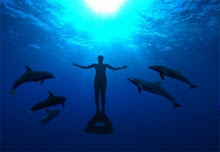
This page is dedicated to the ocean and marine animals, join me as I dive the depths to discover the secrets of the fascinating marine animals.Love the ocean.Protect the ocean.
The Irukandji Jellyfish (Carukia barnesi) inhabits waters of Australia. This is a deadly jellyfish, which is only 2.5 centimeters (with bell and tentacles) in diameter, which makes it difficult to spot.
The term Irukandji refers to an Australian Aboriginal tribe that inhabited the Palm Cove region of northern Queensland where the Irukandji syndrome, produced by the irukandji stings poison, occurs most often.This is a species of jellyfish that has been known about in recent years, due to deaths of swimmers in Australia.
The jellyfish itself was identified in 1964 by Dr. Jack Barnes.
Irukandji has stingers not only on its tentacles but also on its bell.
Irukandji is very small and fragile, it cannot be kept in a normal aquarium because if they hit the side the impact will kill it. It is very fragile yet very deadly!
Irukandji syndrome symptoms:
The initial sting is typically mild and is followed, minutes to hours later, by vomiting, profuse sweating, headache, agitation, rapid heart rate and very high blood pressure and the worst pain throughout the body. The increase in blood pressure may be life-threatening and can be associated with abnormal heart beat and heart failure. The symptoms may last from hours to several days, and victims usually require hospitalisation. The survival depends on whether the body can withhold the shooting high blood pressure. There is no antidote for the venom of irukandji, the treatment is symptomatic. This includes giving IV morphine(still cant relief the pain some victims ecperience), alpha-blockers, fluids.
Irukandji attack prevention
Lycra stinger suits.
Some beaches erect enclosures ,stinger nets, but Irukandji can still filter through the net. Take the right precautions, you can take steps to minimize the exposure and still enjoy all the wonderful beauty of the reef. Talk to specialised dive operators for further advice. Please remember to get out of the waters if you feel tiny bits of sting and see nothing.
Here is another video of Irukandji attack. Enjoy.
Lastly, I would love to wish all divers and snorkelers around the world to be in the waters safely and have wonderful experience in the sea.
Thank you.
Please leave comments and thoughts in the chatbox at the bottom of page.
Merry Christmas everyone... On this festive day, I am bringing you to somewhere special. So hop in the boat and we are heading to Christmas Island!
Christmas Island is an Australian Non-self Governing External Territory, located in the Indian Ocean on the rim of South East Asia, 360km south of Java and 2600 km North West of Perth.
The Christmas Island red crab is by far the most obvious of the 14 species of land crabs found on Christmas Island. It is estimated that 120 million of these bright red land crabs live in their preferred shady sites all over the island.
What is so special about this red crabs?
It is The Annual Migration To The Ocean
At the beginning of the wet season (usually October / November), most adult Red Crabs suddenly begin a spectacular migration from the forest to the coast, to breed and release eggs into the sea.
Below is the video to show its impressive swamp of red invading the town. Basicly everywhere in the island.
I find the rule in golf impressive! Perhaps that is the only place in the world where crabs can help you score in golf game. They are helpful in some ways. =)
Bright red is the common colour but there are the occasional orange specimens and more rarely some purple animals. They are a big crab. An adult body shell (or carapace) may measure up to 116mm across. The Christmas Island red crabs' carapace is round shouldered and encloses their lungs and gills.
Their claws are usually of equal size unless one is a regrowing claw. Males grow larger overall than females, while females have a much broader abdomen and usually have smaller claws than males.
Christmas Island red crabs grow slowly, reaching about 40mm in carapace width after 4-5 years. They are sexually mature at this age and begin to participate in the breeding migrations.
The Christmas Island red crabs moult their shells regularly during their early growth phases to match their increasing body size. Moulting usually takes place in the protected moist environment of their burrows. Mature Christmas Island red crabs probably moult only once a year, as their growth rate slows.
Red Crab Diet
Red Crabs diet consists mainly of fallen leaves, fruits, flowers and seedlings. They prefer fresh green leaves but will eat any fallen leaves. They are not solely vegetarian however. They will eat other dead crabs and birds, the introduced Giant African snail and palatable human rubbish if the opportunity presents itself.
Red Crab Habitat
Red Crabs are diurnal (active during the day) and almost inactive at night despite lower temperatures and higher humidity.
Crabs retreat into the humid interior of their burrows during the dry season. They plug the burrow entrance with a loose wad of leaves to maintain a high humidity level, and effectively disappear from view for up to two to three months of the year.
The Breeding Calendar
Males lead the first wave of the downward migration and are joined by females as they progress. Larger males arrive at the sea first (after about 5-7 days) but are soon outnumbered by females.
The crabs replenish moisture by dipping in the sea, then the males retreat to the lower terraces to dig burrows. The density of burrows is high (1-2 per square metre and fighting occurs between males for burrow possession. The females move to the terraces and mating occurs, usually in the privacy of the burrows that males have dug and fought for.
The females produce eggs within 3 days of mating and remain in the moist burrows on the terraces for 12-13 days while they develop. The eggs are held in a brood pouch between their extended abdomen and thorax. A single female can brood up to 100,000 eggs.
In the morning and late afternoon around the last quarter of the moon, the egg-laden females descend from the terraces to the shoreline. They pack into shaded areas above the waterline at densities of up to 100 per square metre in places. The females usually release their eggs into the sea toward dawn, around the turn of the high tide. Release of eggs may occur on 5-6 consecutive nights during the main breeding migration. After the first two days, eggless females may be seen crossing plateau roads, kilometres from the shore.
If the spawning migration is delayed or disrupted, usually because of unfavorable weather conditions, both male and female crabs will remain on the terraces for the next month and complete the spawning one lunar month later.
Larvae Grow To Baby Crabs In The Sea
The eggs released by the females hatch immediately on contact with the sea water and clouds of young larvae swirl near the shore before being washed out to sea by waves and tides. Millions of the larvae are eaten by fish and plankton feeders such as Manta Rays and the enormous Whale Sharks which visit Christmas Island waters during the crab spawning season.
After about a month in the ocean, and after growing through several larval stages, the surviving larvae have developed into prawn-like animals called megalopae. The megalopae gather in pools close to the shore for 1-2 days before changing into young crabs and leaving the water.
Impact Of Humans Certain human activities have led to increased numbers of Red Crabs dying during their annual migration to the sea.
To reduce the number of crabs killed by vehicles during the migration, 'crab crossings' are being constructed in roads which cross main crab migration paths. Points where high numbers of Red Crabs cross roads have been identified, and tunnels are built under the road for crabs to pass through. Walls that the crabs can not climb over are built alongside the road to 'funnel' the migrating crabs through the tunnels. These crab crossings may be seen on the Lily Beach road. Other conservation measures used by the community are road closures and traffic detours around the major migration paths during peak periods of the migration.
The Annual Migration To The Ocean
At the beginning of the wet season (usually October / November),
most adult Red Crabs suddenly begin a spectacular migration from
the forest to the coast, to breed and release eggs into the sea.
The timing of the migration breeding sequence is also linked to the phases of the moon, so that eggs may be released by the female Red Crabs into the sea precisely at the turn of the high tide during the last quarter of the moon. It is thought that this occurs at this time because there is the least difference between high and low tides.
Movement peaks in the early morning and late afternoons when it is cooler and there is more shade. If caught in open areas, in unshaded heat, the crabs soon lose body water and die.
Have a Merry Christmas and Happy New Year 2010! ! 2009 has been a remarkable year for me, some of the unhappiest thing and happiest things happen to in 2009. Certainly a year to remember in my diary. Be safe and take care.
Love the Ocean. Protect the Ocean.
Please leave your comments in the chatbox at the bottom of page. Thank you.
The most fascinating and colourful creature on earth has to be the nudibranchs or sea slugs. Always fascinated by the array of colour combination they demonstrate and the ability to camouflage. Almost a new species is found everyday. Up till now there are more than 3000 species known to human. Sorry for those who misread the title of this post, but this is a perfectly healthy page dedicated to the marine animals. Come on…
Nudibranchs or sea slugs represent fascinating and colourful life form. Their name is pronounced nudi - brank and it means "naked gill". As the name suggests the vast majority have gills outside their body and they have evolved without the protection of a shell. In all nudibranchs the shell is only present in the larval stage. As adults, the mantle replaces the shell.
They can be found throughout the world's oceans at all depths. The only place you will not find them are high energy areas, such as heavy surf close inshore where their soft body could be damaged.
Anatomy of Nudibranch
The mantle.
The surface of the mantle may bear tubercles which vary in size, shape and number and are often a character used to identify nudibranchs. Acid glands and/or spicules are incorporated in the mantle tissue and it is thought that these are mainly defensive in function.
Processes found in some species have coloured tips and contain defensive glands and have been shown to produce chemicals distateful to fish.
Cerata
The cerata contain branches of digestive gland.
The rhinophores.
The head region of nudibranchs bears a pair of sensory tentacles called rhinophores. These structures are primarily chemosensory (smell, taste) in function. In many dorid nudibranchs the rhinophores can be retracted into a basal sheath. The shape of the rhinophores varies greatly from one species to another and a table showing the different types of rhinophore found in British nudibranchs is provided to help identification.
The gills.
In nudibranchs the gills are probably the most important respiratory organ, however gaseous exchange also occurs over the entire body surface. In dorids the gills consist of several feather-like structures that encircle the anus. The gills can be retracted into a gill-pocket.
The oral tentacles.
Many nudibranch species have a pair of processes, one on either side of the mouth, which are probably involved in identifying food by taste or touch.
Feeding Nudibranchs feed on other invertebrates such as sponges, soft corals,
anemones, sea pens, Portuguese man-of-wars and hydroids.
Certain species are specific about their diet and feed only on a single or small selection of hosts, others are generalised browsers.
Certain species eat the eggs of other nudibranchs. These tend to be pale in colour so that they can go unnoticed on the egg masses. Sneaky!
Defence Nudibranchs have an amazing array of defences. Colour is believed to be an important defence in many species. Others ingest and utilise the stinging cells from soft corals.
Particular species bury themselves in the sand and others hide during the day coming out at night.
They do not have shell for protection, but they use highly sophisticated chemical warfare. When distressed, some species secrete toxins so deadly that it could kill marine animals within 50cm radius.
They obtain this toxin from their food source containing chemical compounds which they store. Some species accumulate the poison in their Cerata, tentacle type sacks located along their backs away from their head, others store in the dorsal body wall.
The striking colour is for camouflage and as a warning to predators not to eat them because they are poisonous or pretending to be.
They travel by producing slimey mucus and using muscle or hair movement on the fleshy foot.
Reproduction
They are hermaphroditic possessing both male and female reproductive systems. Their gonad is located on the right side of their body close to the head as shown below.
Each nudibranch is both male and female producing sperm and eggs. To mate, two nudibranchs come together side by side and pass sperm sacs through a tube in their 'neck' to each other as shown in picture below.
Both then go their own way and lay egg masses that may contain millions of eggs.
The egg mass, which in most cases is laid in an anticlockwise spiral is made up of thousands of small eggs giving a speckled appearance.
Nudibranchs life span vary from 4-5 weeks to one year.
Spoil yourself with the beautiful colours of nudibranchs!
Spanish Dancer
One of my favourite nudibranch is the Spanish dancer.
This is the largest species of nudibranch, which can grow to as much as two feet in length. This specimen is about a foot long. Spanish Dancers are often seen swimming through the water in peculiar movement which is fascinating for divers to watch, as they simultaneously bend their body up and down, and move the edges in a wavelike motion.
The Spanish dancer dances as the diver gazes…
They definitely have the nicer costume than the Spanish dancers I paid through my nose to watch them do the flamenco dance in Barcelona, Spain!
See what I mean? OL attire for Flamenco dance...
No offense to the dancer cause her flamenco dance was really skilled.
But I'd rather gaze at the spanish dancer nudibranchs as they grace through the water. =)
That is what makes our marine lives so precious.
I would like to dedicate this post to my friends who are troubled with unhappy things in their lives at the moment. Hope that you will be strong in this difficult phase of your life and paint your life with beautiful colours of joy and happiness once again. God bless you.
May your life be as colourful as the living colour of the ocean, nudibranchs. Love you all.
Love the Ocean. Protect the Ocean.
Please leave comments and thoughts in the chatbox at bottom of page. Thank you.
I would love to see things change, in the favour of our precious marine animals. Allow me to plant the seed of love for the ocean in your heart and share with you that there are so much more about the ocean apart from being big and blue. Join me for more adventures! Love the ocean. Protect the ocean.
The ocean and marine animals are suffering in silence. It needs help from us. Hopefully through understanding, it can help reduce harm to them. I hope you will love the ocean and make your life as exciting and meaningful as much as it has done for me. Love The Ocean. Protect The Ocean.
 The Irukandji Jellyfish (Carukia barnesi) inhabits waters of Australia. This is a deadly jellyfish, which is only 2.5 centimeters (with bell and tentacles) in diameter, which makes it difficult to spot.