Wednesday, 16 March 2011

Beluga whale

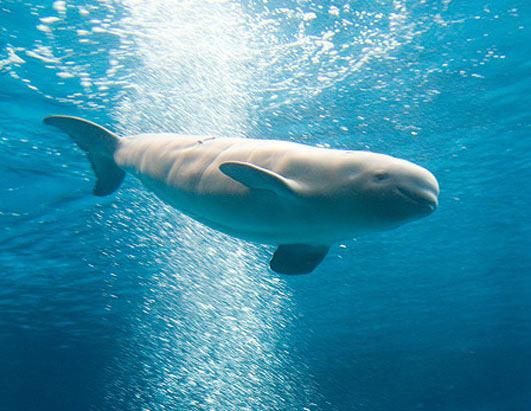
HI everyone! It has been a long time since I posted the last blog, it is great to be back to this underwater world. I have the privilege of going to Harbin, China on February and I met two gorgeous Beluga whales in Harbin aquarium. They were brought in from North pole, where their natural habitat is and they were trained to do shows for us in order for us to understand more about ther species in effort to protect them.


Belugas at Harbin Aquarium

I have never thought I would be able to see Beluga so close up, literally inches away in the aquarium swimming freely and having lovely smiles on their faces. Although the water space they were put in is very small compared to the big ocean that they used to live in, hopefully they will be able to understand the purpose of them being kept there and be able to thrive in the aquarium.

The word beluga comes from the Russian word "bielo" meaning white.

Baby Belugas are born gray to enable them to hide in their mother's shadow and gradually turn snow white to blend with the ice and snow. (PIC) Their bulbous forehead, called a "melon", is also flexible and capable of changing shape by blowing air around its sinuses. This allows them to make different facial expressions and produce a series of chirps, clicks, whistles and squeals, which give the beluga its other name, "the canary of the sea.

Belugas, like other arctic whales, do not have dorsal fins (a dorsal fin causes extra heat loss and would be a major hindrance in the arctic ice), but they do have a tough dorsal ridge. They also have a thick layer of blubber that insulates them from the icy arctic waters. They travel in a group of 5-20 animals, but sometimes more than one thousand are spotted together. They consume various fish species, squid, and krill. It most probably does not dive any deeper than 300 m.

The females reach puberty at the age of five and the males at eight. Mating takes place when the ice melts, the gestation period is about 14 months and the calf is 1½ m long and weighs 80 kg at birth. They start turning white 5-12 years of age. No other whale species produces such a variety of high frequency sounds and only two other species can move their heads as freely as the beluga whale.

This is a video of Beluga performance that is found in Youtube, not the same as the one I watched at Harbin, but this showcase how intelligent they are. Enjoy!


This video shows a birth of a baby beluga whale at Shedd aquarium Chicago. Puiji is the mother and the calf is Ninavik. =)


Thank you and i shall see you soon! have a nice day.

Love the Ocean. Protect the Ocean.

For more information, please log on to :

http://www.enchantedlearning.com/subjects/whales/species/Beluga.shtml


http://www.solarnavigator.net/animal_kingdom/cetaceans/beluga_whale.htm

I hereby pray that all the people that have died from the earthquake and tsunami in Japan to rest in peace and their family to be blessed with safety and happiness. May God and the ocean be with you.

Monday, 3 May 2010

Puffer Fish

Puffer Fish are probably one of the fish in the sea that shows its emotions through body language. When relaxed and calm, puffer fish has this little mouth that its shape almost suggest that it is smiling welcomingly.


But when it is provoked, it definitely will let you know that it is pissed!


I sure do envy puffer fish, if only I can puff up like a ball with poisonous spines when there is danger. Then I can get rid of my stupid protective alarm that goes off all of sudden in class, and I can throw away my pepper spray that is difficult to use in emergencies. But what if I can’t deflate myself afterwards,…hmm…anyway, the point is, the puffer fish, being small relatively, has got nature’s gift to ultimately protect itself from predators.

The puffer fish can puff up to 2-3 times its usual size! It only does that when it is put into tremendous stressful condition. Aquarium keepers are advised not to transfer a puffer fish out of water, because puffing air is much more dangerous for the fish than puffing water.

The ability to puff is very important for puffer fish because they move slowly and clumsily in the water, will not have enough time to escape from predators if they are under attack. They use their highly elastic stomachs and the ability to quickly ingest huge amount of water to turn themselves into a virtually inedible ball several times larger than their normal size. Some species have spines on their skin to make them even less palatable.

Predators that manage to snag a puffer fish before it inflates might laugh away feeling lucky, but it will not feel lucky anymore to know that almost all puffer fish contain tetrodotoxin. This substance makes them foul tasting and lethal to fish. Tetrodotoxin is deadly to human, it is up to 1,200 times more poisonous than cyanide. One puffer fish has toxin enough to kill 30 adult humans, and there is no known antidote! Don’t mess with a puffer fish.


Okay, maybe only if you are a professional.


Puffy Puffer Fish Puffs! :p


I hope all of you will get puffed up with joy and warmth in your heart and say no no to ego. This is my 10th post since November 2009 and I am absolutely thankful and happy for those who visits this page on a regular basis. With God’s grace I shall continue my little contribution to the ocean, marine animals and the nature and continue this cause for the rest of my life. May you join me as well and together we can make a difference.

Love the Ocean. Protect the Ocean.

For more information, please visit:

http://animals.nationalgeographic.com/animals/fish/pufferfish.html


http://www.pufferfish.net/

p/s: I recently found out that Ellen Degeneres is actually the voice of Dory in Finding Nemo!! Silly me, took me so long to realize, but i just feel it is absolutely amazing that one of my favourite hosts is my favourite fish in cartoon!! okay, it doesn't sound right but who cares! wohoo... hehehe..... bye guys!

Wednesday, 14 April 2010

Just keep flapping...flapping...flapping

Hello peeps!! Hope you are out enjoying the sun! Growing up watching Disney’s cartoons, I love almost all Disney cartoons and can memorize most of them even their songs! Many of the ideas that Disney cartoon came from the nature and animals. How many kids got named after Disney characters, because their parents want them to grow up as adorable as their favourite characters. The only marine animal in the ocean that is named after a Disney character actually has the feature of the Disney character, Dumbo, which is why it is given the name Dumbo Octopus. This is how it looks like...


Dumbo Octopus

Perhaps this video can bring back sweet memories of sitting in front of TV with siblings and crying over touching story of Dumbo… =)


Unlike other species of octopus, Dumbo octopus has ear like fins which helps it moves gracefully in the deep sea, around 300-400 meters below surface. It has soft body(semi-gelatinous), which allows it to live in great depths. It swims by flapping its fins, expanding and contracting its webbed arms, or by shooting water through its funnel. All of these techniques can be used separately or simultaneously. This make them really good swimmers and escapers when under attack.


It is an octopod, which means it has 8 arms. The arms are connected to each other, close to the tip, which is called webbing. It can grow up to 8 inches. The size and the pattern of suction pads vary between the male and female Dumbo Octopus. It feeds on shrimps, small fish and worms. Dumbo octopus differs from other species by swallowing its prey as a whole.

There are 14 known species of Dumbo Octopus. They appear to live near the seabed, just above it. They can live up to 7,000 meters of depth, which is the deepest depth of any octopus.

Having found multiple eggs at various developmental stages in dissected females, they presumably lay eggs all year long instead of having a breeding season. The male Dumbo octopus has an enlarged segment on one of his arms which is used to transfer spermatophores (packets of sperm) into the female's mantle cavity. Once transferred, the packets will rupture so the sperm can fertilize the eggs. The female will then lay the eggs underneath rocks and shells and leave them to fend for themselves.

The eggs are usually quite large in size and when hatched, the young are believed to be quite advanced in terms of development.

Here is videos of Dumbo octopus,


Maybe because of its name, I feel very familiar with Dumbo Octopus and think its very adorable as well.

Like Disney cartoons, we should always believe in ourselves, come what may, should never give up and keep trying, and with God’s permission, success will be rewarded. Hope everything goes well for all of you and keep believing and have faith, and most importantly, be happy… cause life is too short to ponder over things, cause the past is a history, the future is a mystery and to have you reading my post right now, is a present.

God bless all of you. Please be safe and sound. See you soon. =)

Love The Ocean. Protect The Ocean.

For more information, visit :

http://www.deepseamonsters.com/component/content/article/63-dumbo-octopus.html


http://www.brighthub.com/environment/science-environmental/articles/62036.aspx


http://www.brighthub.com/environment/science-environmental/articles/62036.aspx#ixzz0jlsbmFWw